

Social problems cannot be simply swept away
Advertisement
Read this article for free:
or
Already have an account? Log in here »
To continue reading, please subscribe:

Digital Subscription
One year of digital access for only $205*
- Enjoy unlimited reading on winnipegfreepress.com
- Read the E-Edition, our digital replica newspaper
- Access News Break, our award-winning app
- Play interactive puzzles
*First annual payment billed as $205.00 + GST for one year. This annual subscription will automatically renew at $233.00 + GST every 52 weeks (10% off the regular annual price of $259.35). Offer available to new and qualified returning subscribers only. Cancel any time.
To continue reading, please subscribe:
Add Free Press access to your Brandon Sun subscription for only an additional
$1 for the first 4 weeks*
- Enjoy unlimited reading on winnipegfreepress.com
- Read the E-Edition, our digital replica newspaper
- Access News Break, our award-winning app
- Play interactive puzzles
*Your next Brandon Sun subscription payment will increase by $1.00 and you will be charged $17.95 plus GST for four weeks. After four weeks, your payment will increase to $24.95 plus GST every four weeks.
Read unlimited articles for free today:
or
Already have an account? Log in here »
In the battle to alleviate homelessness, mental health issues and drug addiction, we just can’t seem to get the order of our response right.
The city dismantles homeless encampments before there are enough safe, permanent places for people to live.
The Winnipeg Police Service conducts an intensive sweep to combat open drug use on Main Street, without arranging support from social service agencies to help the people they are rousting.
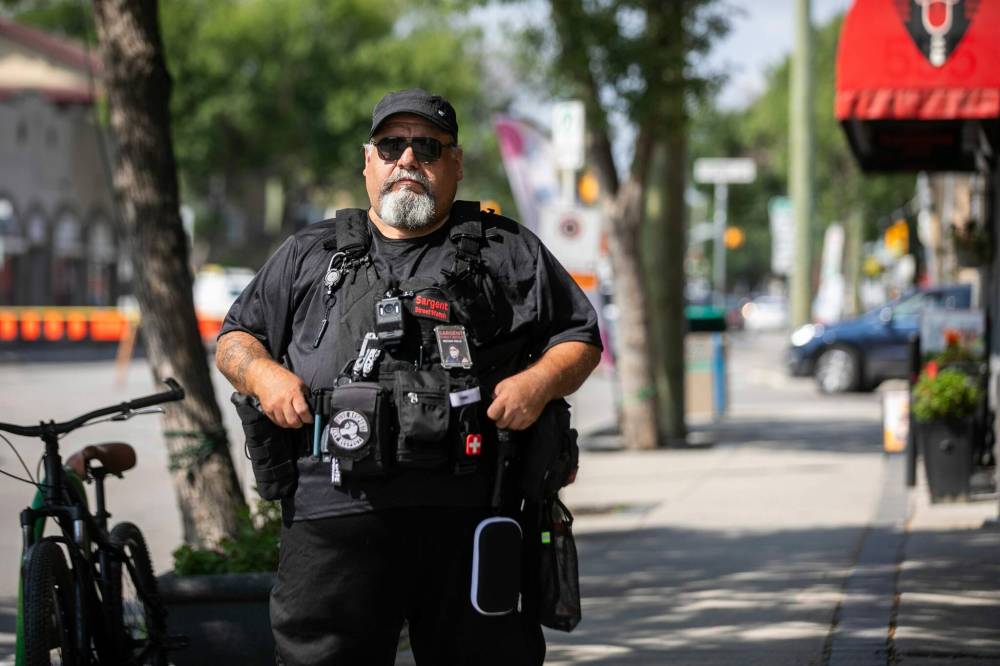
MIKAELA MACKENZIE / FREE PRESS
Michael Paille, executive director of the Sargent Business Community, patrols Sargent Avenue last month.
Is it any surprise that the acute problems being experienced by residents, businesses and workers on Main Street are beginning to manifest in adjacent neighbourhoods? That’s what happens when you try to solve a problem by moving it, not addressing it head-on.
Winnipeg’s West End is a perfect example.
This densely populated, downtown-adjacent neighbourhood has always had its share of problems with homelessness and drug use. But following a 10-day WPS sweep of Main Street in July, the numbers of homeless, addicted and mentally ill people lingering on West End streets increased dramatically, according to some in the neighbourhood.
The Free Press recently profiled West End business owner Michael Paille, who voluntarily patrols Sargent Avenue west of Balmoral Street to keep the peace, clean up discarded drug paraphernalia, aid homeless people in crisis and encourage people not to block access to businesses.
Paille said approximately 100 new people had begun to hang out in the neighbourhood, increasing the level of disorder and open drug use on the normally quiet core street, and raising the threat level significantly.
From talking to people living in the neighbourhood, Paille is convinced they have moved west after being confronted by police on or near Main Street.
“Pushing the problem away doesn’t solve homelessness or violence, it just shifts the burden elsewhere,” Paille said.
The reaction to Paille’s story, and his urgent plea for more assistance, has been underwhelming.
A spokesman for Mayor Scott Gillingham said his office was in contact with the WPS and the Safe Winnipeg Initiative to provide additional resources to address the new threat in the West End. However, the WPS refused to comment on what, if anything, it would do.
Similar stories are unfolding in St. Boniface, West Broadway and Osborne Village, where residents and business owners have noted an increase in the number of homeless people and problems such as open drug use in the wake of the Main Street police sweep.
What is most frustrating is that this is a problem wrought of a phenomenon that is well known to law enforcement, social service agencies and urban planners.
Problems such as homelessness — and all the collateral issues it implies — are never solved by sweeping the problem from one neighbourhood to another. In fact, there is a strong argument to be made that this strategy of expedience has made these problems significantly worse.

It would be unfair to say that the three levels of government are doing nothing to address the foundational issues of homelessness, drug abuse and mental health. Millions upon millions of dollars are being spent and some of that spending — particularly provincial expenditures on permanent housing for the homeless — is seeing some success.
But the growth in the magnitude of these problems outpaces our best efforts at finding solutions.
Government must start by establishing some sort of interim housing solution so that homeless people have somewhere to go while more permanent accommodation with wrap-around social services can be provided. This interim solution — a managed encampment, for example — would allow police to relocate people somewhere safe, rather than nudging them towards a new neighbourhood.
It’s time for police, government and social service agencies to start delivering solutions for homelessness, addictions and mental health in the right order.
Otherwise Winnipeg will face a future in which the problems become too big to solve.