

StatCan reports merchandise trade surplus grew to $3.9B in June
Advertisement
Read this article for free:
or
Already have an account? Log in here »
To continue reading, please subscribe:

Digital Subscription
One year of digital access for only $205*
- Enjoy unlimited reading on winnipegfreepress.com
- Read the E-Edition, our digital replica newspaper
- Access News Break, our award-winning app
- Play interactive puzzles
*First annual payment billed as $205.00 + GST for one year. This annual subscription will automatically renew at $233.00 + GST every 52 weeks (10% off the regular annual price of $259.35). Offer available to new and qualified returning subscribers only. Cancel any time.
To continue reading, please subscribe:
Add Free Press access to your Brandon Sun subscription for only an additional
$1 for the first 4 weeks*
- Enjoy unlimited reading on winnipegfreepress.com
- Read the E-Edition, our digital replica newspaper
- Access News Break, our award-winning app
- Play interactive puzzles
*Your next Brandon Sun subscription payment will increase by $1.00 and you will be charged $17.95 plus GST for four weeks. After four weeks, your payment will increase to $24.95 plus GST every four weeks.
Read unlimited articles for free today:
or
Already have an account? Log in here »
OTTAWA – Canada’s merchandise trade surplus increased to $3.9 billion in June as a weaker loonie pushed trade values higher, Statistics Canada said on Tuesday.
The agency said the result compared with a surplus of $3.7 billion in May, which was revised from its initial reading of $4.2 billion.
StatCan noted the average value of the loonie, which affects trade transactions, dropped 1.7 cents US in June compared to May, the largest monthly decline since October 2022.
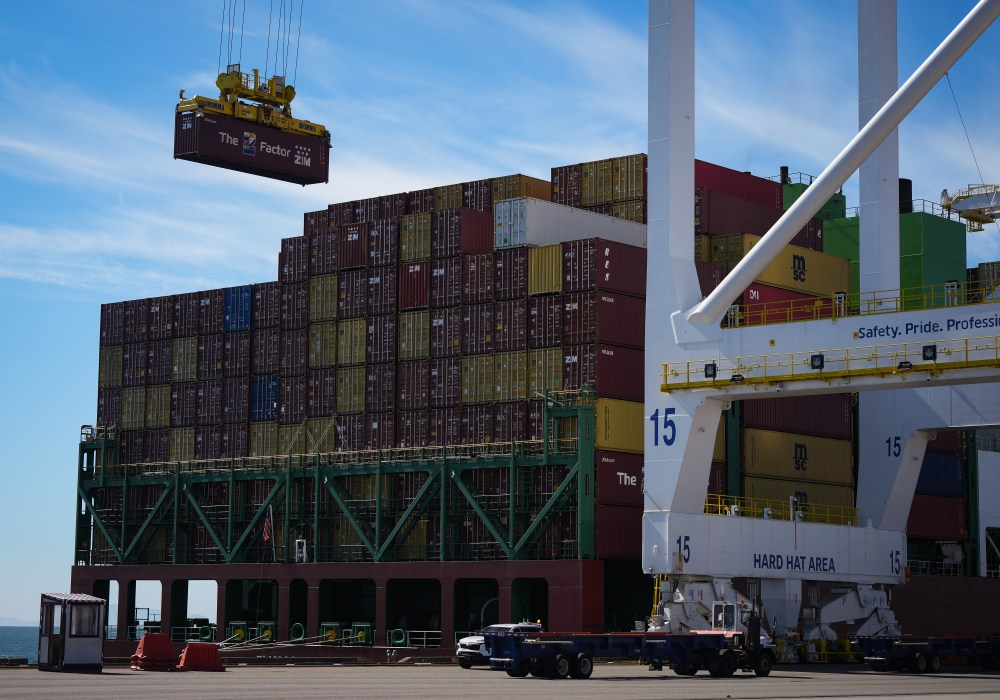
It said a weaker loonie pushed monthly trade values in Canadian dollars higher. When expressed in U.S. dollars, it said exports declined two per cent in June, while imports dropped 2.1 per cent.
In Canadian dollars, total exports gained 0.4 per cent in June to post the fifth consecutive monthly increase and hit a record $77.5 billion.
Exports of metal and non-metallic minerals rose 16.5 per cent, boosted in part by higher gold shipments.
The overall gain in exports was largely offset by a 10 per cent drop in energy product exports in June as oil prices fell.
Total imports edged up 0.2 per cent in June to $73.6 billion, largely driven by a 59 per cent surge in computers and computer peripherals imports, such as processing units used in data centres. Computer and computer peripherals shipments were also a primary reason imports from the U.S. rose three per cent, the agency said.
In volume terms, total exports were up 1.1 per cent, while imports were down 1.5 per cent.
Meanwhile, StatCan said total exports in the second quarter rose 13.1 per cent, the strongest quarterly increase in percentage terms since the third quarter of 2020.
Almost half of the increase came from higher energy products exports, as oil prices rose amid the conflict in the Middle East, StatCan said. Exports of motor vehicles and parts were also up 19.3 per cent, following two quarters of declines.
“June’s data confirm that a further rebound in export volumes from the lows seen in 2025 appears to have been a large driver of the strength in GDP signalled” for the second quarter, said Andrew Grantham, senior economist at CIBC Capital Markets, in a note on Tuesday.
But he said the threat of new tariffs could slow or stall that momentum.
“Export volumes could see a small bump in the next couple of months if companies potentially impacted by new U.S. tariffs look to front-run their implementation, but there would be a negative effect afterwards if these new tariffs actually come into effect,” Grantham said.

The U.S. government announced last month a plan to impose a 50 per cent tariff on hundreds of categories of Canadian goods. The tariffs are slated to take effect on Aug. 19 and would be imposed using an obscure legal tool dating back to the Great Depression.
Marc Ercolao, senior economist at TD, said the annual reviews of the Canada-U.S.-Mexico trade agreement will further prolong trade uncertainty.
In a separate release, StatCan reported monthly service exports edged down 0.2 per cent to $20.8 billion, while imports of services fell 0.4 per cent to $21 billion.
Combined, goods and services exports increased 0.3 per cent to $98.2 billion in June, while imports edged up 0.1 per cent to $94.7 billion.
This report by The Canadian Press was first published Aug. 4, 2026.