Feds move to repeal EV sales mandate without new stringent emission rules in place

Advertisement

Advertise with us

OTTAWA - The federal government moved last week to formally repeal the electric vehicle sales mandate, but the more stringent emission standards Prime Minister Mark Carney promised to replace it with is not close to being finalized.

Read this article for free:


or

Already have an account? Log in here »

To continue reading, please subscribe:

Subscribe and receive a limited-edition Free Press branded hat or tote.

Digital Subscription

One year of digital access for only $205*

  • Enjoy unlimited reading on winnipegfreepress.com
  • Read the E-Edition, our digital replica newspaper
  • Access News Break, our award-winning app
  • Play interactive puzzles

*First annual payment billed as $205.00 + GST for one year. This annual subscription will automatically renew at $233.00 + GST every 52 weeks (10% off the regular annual price of $259.35). Offer available to new and qualified returning subscribers only. Cancel any time.

To continue reading, please subscribe:

Add Free Press access to your Brandon Sun subscription for only an additional

$1 for the first 4 weeks*

  • Enjoy unlimited reading on winnipegfreepress.com
  • Read the E-Edition, our digital replica newspaper
  • Access News Break, our award-winning app
  • Play interactive puzzles
Start now

*Your next Brandon Sun subscription payment will increase by $1.00 and you will be charged $17.95 plus GST for four weeks. After four weeks, your payment will increase to $24.95 plus GST every four weeks.

OTTAWA – The federal government moved last week to formally repeal the electric vehicle sales mandate, but the more stringent emission standards Prime Minister Mark Carney promised to replace it with is not close to being finalized.

In a notice in the Canada Gazette posted on Friday, the government outlined the proposed regulations to repeal the mandate, which would have set a target of having EVs account for at least 20 per cent of auto sales across Canada this year. The target was to increase to 100 per cent by 2035.

The government forecasted the change would drive the adoption rate of EVs to 75 per cent of new sales by 2035, and 90 per cent by 2040.
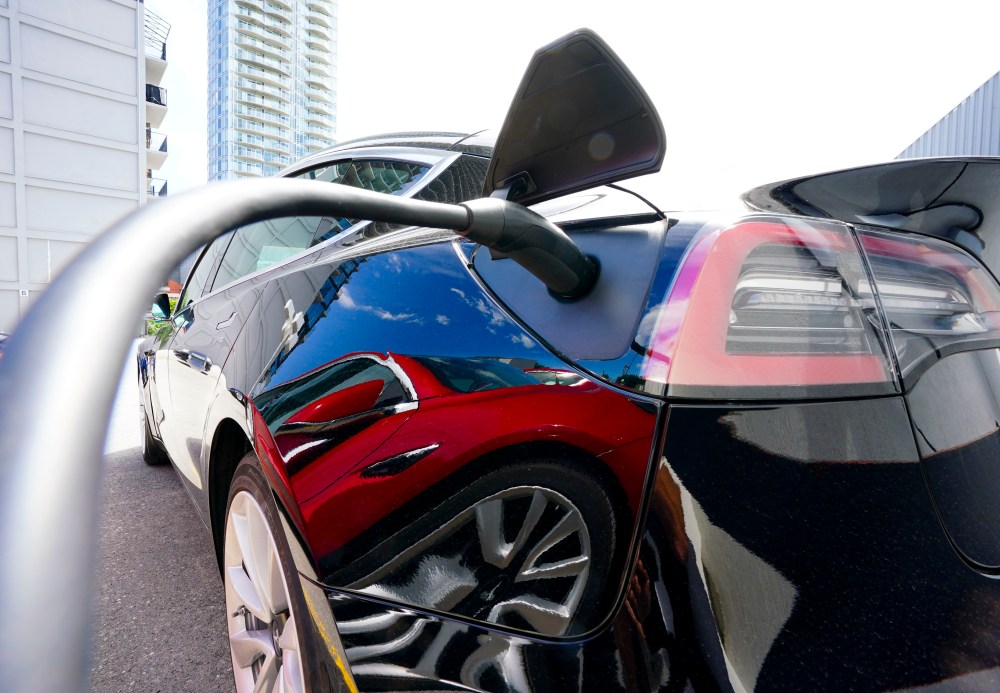
An electric vehicle is charged in Ottawa on Wednesday, July 13, 2022. THE CANADIAN PRESS/Sean Kilpatrick

The mandate is among a growing list of climate policies introduced by former prime minister Justin Trudeau which Carney is dismantling, including repealing the consumer carbon price and scrapping the emissions cap on oil and gas production.

The government acknowledges that ending the sales mandate would slow the rate of adoption of EVs, and could cause $90.3 billion in “potential climate change-related global damages.”

The EV mandate was expected to reduce Canada’s greenhouse gas emissions by 376 million tonnes over 25 years — or annually about the emissions produced by three million cars — though the estimate is based on the amount of greenhouse gas emissions without factoring in new standards for emissions from gas-powered passenger vehicles.

Carney promised those more stringent tailpipe standards when he announced the plan to repeal the mandate in February. But on Monday, the government said it’s only set to begin consultations on the new tailpipe standards in the fall.

Environment Minister Julie Dabrusin was unavailable for an interview Monday on the plans.

“Getting this right is paramount for our economy and our environment,” Dabrusin’s press secretary Keean Nembhard wrote in a statement, adding Ottawa is also planning to launch a national charging infrastructure strategy in the coming months.

“That is why we are launching a new round of consultations, not just with the auto industry but also with environmental groups.”

A senior government official, speaking on background, said Ottawa is aiming to have draft regulations in place by early 2027. Multiple environment organizations told The Canadian Press they expected the draft regulations to be ready by the end of June.

“We were expecting this to come out a long time ago. Initially, we heard this was gonna come out in early summer, and we were told that over and over again,” said Sam Hersh, the clean transportation program manager at Environmental Defence.

“Climate hasn’t necessarily been a priority for this government. So I’m not really surprised that they sort of were so willy-nilly with this sort of thing.”

Carney first paused, and then ultimately said he would scrap the mandate, following pressure from provinces and carmakers who argued there were better ways to reduce emissions without potentially penalizing car manufacturers for not hitting their targets — particularly as the auto industry has been hammered by the trade war with the United States.

Carney said in February the new emissions standard will set a maximum of 74 grams of carbon dioxide, or its equivalent, per mile. That’s down from the current federal tailpipe emissions standard of 172 grams per mile — a 56.9 per cent reduction — which remains in effect.

At the time, government officials said they were still working on the path to get to the 74 grams per mile figure. One official said the work would happen through the regulatory process, with initial regulations targeting the 2027 to 2032 model years.

Environment groups say repealing the EV sales mandate without having the new tailpipe standards in place risks jeopardizing EV adoption, as other countries forge ahead with more EVs on their roads.

Joanna Kyriazis, the director of policy and strategy at Clean Energy Canada, said tailpipe emission standards are already prominent in most other regions around the world — except for the United States.

“As a result, other markets continue to see record-breaking EV sales, more affordable EVs on the market, more fuel efficient gas-powered vehicles available to their drivers at a time when gas prices are high and continually impacted by global geopolitical events,” Kyriazis told The Canadian Press.

“At this point, Canadians are being deprived of those options and exposed to volatile gas prices, that are just exacerbating their kind of cost of living challenges.”

This report by The Canadian Press was first published Aug. 17, 2026.

Report Error Submit a Tip

More Stories

Today’s horoscope

Georgia Nicols 4 minute read Yesterday at 2:00 AM CDT

MOON ALERT: Caution! Avoid shopping (except food and gas) and important decisions after 9 a.m. today. After that, the moon moves from Libra into Scorpio.

ARIES (March 21-April 19)

Discussions with partners, spouses and close friends will be exciting but unpredictable. You might also meet a real character — someone exciting. Alternatively, someone you know might do something to surprise you. Check moon alert!

TAURUS (April 20-May 20)

A father and son arrested last month are accused of travelling across Canada — and using courier services and Canada Post — to supply their Winnipeg drug-trafficking operation, a recent court filing shows.

Devinder Singh, 57, and his 32-year-old son Tarundev Singh, charged by Winnipeg Police Service organized crime investigators last month, are each accused of several counts of conspiracy to commit an indictable offence and related drug-trafficking offences, court records show.

Tarundev is also charged with several firearms offences.

Details of the pair’s alleged trafficking operation and the ongoing police investigation — dubbed Project Pink Panther — are contained in a lawsuit filed in the Court of King’s Bench by the provincial civil forfeiture office this week.

Young Winnipeg Jet hopeful, Viggo Bjorck, shines brightly in prospects tournament

Mike McIntyre 6 minute read Preview

Young Winnipeg Jet hopeful, Viggo Bjorck, shines brightly in prospects tournament

Mike McIntyre 6 minute read Yesterday at 4:59 PM CDT

It’s safe to say Viggo Bjorck made plenty of new friends and fans this past weekend — including members of his own Winnipeg Jets prospects team which split a pair of tournament games in Quebec.

Take Davis Burnside for example. The undrafted 22-year-old forward, who signed with the Manitoba Moose last spring after finishing up at Ohio State University, couldn’t believe his eyes when he was put on a line with Bjorck, the eighth-overall pick from this summer’s draft and one of the most exciting young players in 2.0 Jets history.

“You see all the highlights and you just can’t wait to play with him,” said Burnside.

It wasn’t long before they teamed up for a highlight of their own. Bjorck made a sensational through-the-legs, no-look pass to Burnside on Sunday afternoon, setting him up for a shorthanded snipe in an eventual 6-4 loss to the Toronto Maple Leafs young guns.

Read
Yesterday at 4:59 PM CDT

Contact Us

6 minute read Monday, Jul. 27, 2026

Contact UsJUMP: Editorial

Delivery

Promotions

Advertising |Photo Reprints

Privacy Inquiries

Newsmedia Council

By TelephoneIf the number you need is not listed below, call the Winnipeg Free Press main switchboard, at 204-697-7000, it's open Monday to Friday 8 a.m. to 4 p.m. All numbers are area code204 unless otherwise noted.

E-Mailfpcirc@freepress.mb.ca |

Citizen reports help highlight connectivity issues across southwest Manitoba

Nicole Buffie 5 minute read Preview

Citizen reports help highlight connectivity issues across southwest Manitoba

Nicole Buffie 5 minute read Saturday, Sep. 12, 2026

A southwestern Manitoba man has created a map to document cell service blackout spots in an effort to push for better access in rural areas.

Mark Custance compiled more than 300 citizen reports over the last few months to document where service in southwest Manitoba is strong, spotty or doesn’t exist at all.

“I’ve heard people complain and say, ‘cell service sucks’ or ‘this is not working.’ But what does the data actually say?” Custance said from his office in Melita, where he has installed a cell-service booster to maintain connectivity with the rest of the world.

Analyzing where service is good and poor, he cross-references it with the location of cellphone towers across the region.

Read
Saturday, Sep. 12, 2026

The port of Churchill — but done right

Editorial 4 minute read Preview

The port of Churchill — but done right

Editorial 4 minute read Saturday, Sep. 12, 2026

The seagoing grain carrier wasn’t christened with a champagne bottle. There was no confetti or streamers. Nevertheless, the Aug. 31 event marking the first shipment of grain to be loaded at the Port of Churchill since 2020 was celebrated like the launch of a brand new vessel.

The presence of the federal minister of northern and arctic affairs, provincial cabinet ministers and leaders and elders from several northern First Nations signalled that the fast-tracked process of refurbishing and buffing up Manitoba’s deep-water seaport gem is gaining momentum.

For OneNorth, the partnership of 29 First Nations and 12 northern communities which owns the Port of Churchill and the Hudson Bay Railway (both operated by the Arctic Gateway Group) the event heralded a new beginning. It’s been eight years since OneNorth purchased the port and railroad, and six years since grain was moved by rail through Manitoba and then by ship to European markets. Two more grain shipments, plus shipments of potash and critical minerals, will continue through the fall.

When Prime Minister Mark Carney solicited the premiers to suggest “nation-building” projects following his election in 2025, Premier Wab Kinew pitched a Manitoba trade corridor that would move wheat, critical minerals, potash and energy (oil or liquid natural gas) through the Port of Churchill.

Read
Saturday, Sep. 12, 2026