Divided federal appeals court says Trump administration was wrong to terminate climate funds

Advertisement

Advertise with us

WASHINGTON (AP) — A divided federal appeals court on Tuesday said the Trump administration improperly terminated billions of dollars in funds to boost clean energy projects, handing a win to a coalition of nonprofits picked to run the Biden-era effort.

Read this article for free:


or

Already have an account? Log in here »

To continue reading, please subscribe:

Subscribe and receive a limited-edition Free Press branded hat or tote.

Digital Subscription

One year of digital access for only $205*

  • Enjoy unlimited reading on winnipegfreepress.com
  • Read the E-Edition, our digital replica newspaper
  • Access News Break, our award-winning app
  • Play interactive puzzles

*First annual payment billed as $205.00 + GST for one year. This annual subscription will automatically renew at $233.00 + GST every 52 weeks (10% off the regular annual price of $259.35). Offer available to new and qualified returning subscribers only. Cancel any time.

To continue reading, please subscribe:

Add Free Press access to your Brandon Sun subscription for only an additional

$1 for the first 4 weeks*

  • Enjoy unlimited reading on winnipegfreepress.com
  • Read the E-Edition, our digital replica newspaper
  • Access News Break, our award-winning app
  • Play interactive puzzles
Start now

*Your next Brandon Sun subscription payment will increase by $1.00 and you will be charged $17.95 plus GST for four weeks. After four weeks, your payment will increase to $24.95 plus GST every four weeks.

WASHINGTON (AP) — A divided federal appeals court on Tuesday said the Trump administration improperly terminated billions of dollars in funds to boost clean energy projects, handing a win to a coalition of nonprofits picked to run the Biden-era effort.

Climate United Fund and other nonprofits won’t have access to their funds immediately as the decision will be put on hold for several days giving the Environmental Protection Agency time to ask the Supreme Court to step in.

The judgement by the full U.S. Court of Appeals for the District of Columbia is a loss for the Trump administration in one of its earliest efforts to dismantle President Joe Biden’s campaign to reduce climate-warming greenhouse gases. The Greenhouse Gas Reduction Fund, commonly referred to as a “green bank,” is a $20 billion congressionally authorized program that provided money to nonprofits that would then make loans and invest in small energy projects, energy-efficient buildings and transportation.
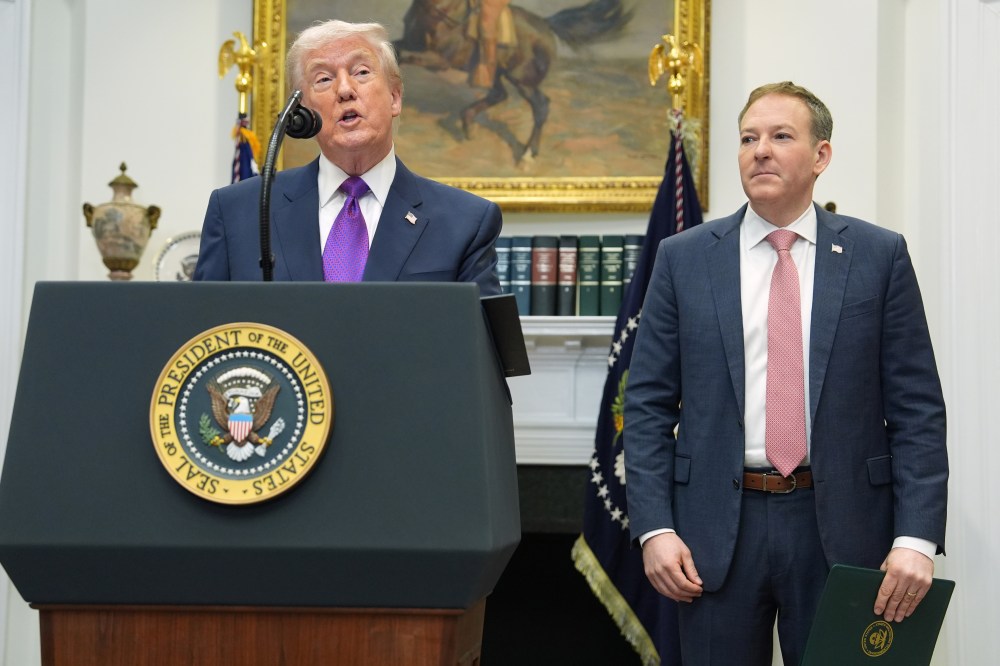
FILE - President Donald Trump, left, speaks during an event with Environmental Protection Agency director Lee Zeldin in the Roosevelt Room of the White House, Feb. 12, 2026, in Washington. (AP Photo/Evan Vucci, File)

EPA Administrator Lee Zeldin accused Climate United Fund and other nonprofits picked to run the green bank of mismanagement and potential fraud. He froze billions that had been placed in a Citibank account for the program and then terminated their grants. The groups disputed any wrongdoing and sued, arguing the Trump administration broke the law and violated the Constitution by not spending money authorized by Congress.

“Despite efforts to harm the awardees with false allegations and misinformation, there remains no legal basis for terminating our grant award and clawing back funds that were already disbursed in our bank accounts,” Climate United said in a statement.

In September, a divided three-judge panel of the same appeals court overturned a lower court and said the Trump administration had broad power to cancel grants without having to face charges of illegality in federal court.

The full appeals court agreed to revisit that decision, a rare occurrence reserved for the most important cases.

Zeldin early last year told Fox News that he suspected the green bank “was a clear-cut case of waste and abuse” that “in my opinion, is criminal.”

U.S. District Judge Tanya Chutkan last year said that when the federal government was asked for evidence of fraud, the agency didn’t provide it and shifted its position to more general concerns about the level of EPA oversight over the program. Chutkan ruled the government can’t violate the law and terminate the contracts and that the groups should have access to some of their frozen money. That order was put on hold during appeal.

A lawyer for the nonprofits argued at the time that the agency had already allocated the money by putting it in the Citibank account for the program’s use.

The agency argued the nonprofits are making constitutional and statutory arguments that don’t apply in a simple contract fight, and that the matter should be heard by a different court that can only award a lump sum — not force the government to keep the grants in place. Federal officials argue there is no law or provision in the Constitution that compels the EPA to make these grants to these groups.

The green bank was created by the 2022 Inflation Reduction Act, a Biden administration priority that boosted clean energy and climate-friendly projects. President Trump’s tax and spending bill last year, however, repealed part of the law that established the bank and rescinded money that hadn’t already been obligated to its recipients. That added a layer of complication to the legal case.

Six of 10 judges agreed with a lower court judge that the Trump EPA likely violated the 2022 law when it terminated the grants and tried to claw back funds based on a policy disagreement.

However, one of the six judges that agreed the grant terminations were improper said Trump’s bill complicated whether the clean energy groups could access funds going forward.

The remaining four judges broadly disagreed with the majority and sided with the EPA, saying that after Trump’s tax and spend bill, the agency likely would have authority to end the grants.

The EPA did not immediately provide comment.

___

The Associated Press receives support from the Walton Family Foundation for coverage of water and environmental policy. The AP is solely responsible for all content. For all of AP’s environmental coverage, visit https://apnews.com/hub/climate-and-environment

Report Error Submit a Tip

More Stories

Perfumer battling city hall to keep his shop open

Gabrielle Piché 5 minute read Preview

Perfumer battling city hall to keep his shop open

Gabrielle Piché 5 minute read Yesterday at 5:45 PM CDT

Michael O’Malley has been here before — fighting the City of Winnipeg to keep his business open.

He usually spends his days concocting scents. He’s owned La Parfumerie, a Wolseley shop, since 1993.

Twenty-seven natural perfumes line shelves on 145 Evanson St.’s bottom floor. O’Malley lives above the space.

Now, he’s required to change the home’s zoning or shut out walk-in customers. Either would kill the company, O’Malley said.

Read
Yesterday at 5:45 PM CDT

AI, animals and us

Jordan Laidlaw 5 minute read 2:00 AM CDT

It is now perhaps axiomatic to declare that artificial intelligence will revolutionize the world, as researchers and industry insiders are projecting the novel technology to become the greatest technological breakthrough in human history.

There has been a flurry of discussion in both our local and international contexts — and with good cause. We must remain steadfast to ensure our youth, local workforces, and environment are not negatively impacted by this burgeoning technology.

I wish to accentuate, however, a somewhat neglected area of public discussion around AI developments. Specifically, we urgently need to re-evaluate the ethos of humanity, particularly cognizant of the emergence of this digitally superintelligent species.

If artificial superintelligence (ASI) is ultimately achieved, leading academics theorize that these digital agents will be sentient, conscious, and astronomically more intelligent and powerful than us. In fact, numerous scholars believe AI to already possess some level of consciousness in its current iteration. This position is held by eminent evolutionary biologist Richard Dawkins, for example.

Wab Kinew as ‘communicator in chief’

Paul G. Thomas 6 minute read Preview

Wab Kinew as ‘communicator in chief’

Paul G. Thomas 6 minute read Yesterday at 2:00 AM CDT

Premier Wab Kinew and his party have been riding high in the polls longer than normal for a government one year or less away from its first re-election contest. One reason is his ubiquitous, dominating communications presence as NDP leader and premier.

The argument here is that Kinew has supplemented his prerogatives as premier and party leader (such as appointing cabinet ministers and approving party nominations) with the skilful use of communications to advance his policy agenda, boost his personal popularity and maintain the competitive advantage of his party over the opposition Progressive Conservatives.

Communications has always been a significant part of politics and policy making. However, in the contemporary political and media environments, communications considerations have moved from the background to the foreground of decision-making by political parties, including when they are performing in the role of government. Campaigning and governing now overlap in what has been described as a permanent election campaign.

Political parties use communications strategies for several purposes: to establish an image of the leader which makes a positive emotional connection with voters; to promote a coherent message and to keep party members on message; and to gain favourable media coverage for its policies and other actions on almost a daily basis.

Read
Yesterday at 2:00 AM CDT

Letters, Sept. 29

7 minute read 2:00 AM CDT

Public servants and elections

We currently are in the midst of elections, mostly on the municipal level. Voters are reviewing policies and promises in anticipation of new programs and commitments that hopefully will enhance their daily life.

While those seeking political office live in anxiety during this time as they await their electoral fate, so too do many civil servants as election results will also determine their futures.

It is these civil servants who we rarely think of at election time.

Province invests $3.8M in culinary arts training facility for francophone high school students

Kelly-Anne Riess 3 minute read Preview

Province invests $3.8M in culinary arts training facility for francophone high school students

Kelly-Anne Riess 3 minute read Sunday, Sep. 27, 2026

A new dedicated culinary arts training facility will give francophone high school students a place to learn the trade in French.

Read
Sunday, Sep. 27, 2026

Letters, Sept. 28

7 minute read Yesterday at 2:00 AM CDT

Other options are closer

Every Winnipeg driver learns this lesson eventually: keep your eyes on the horizon too long and the pothole gets you. Manitoba’s energy debate has the same problem. We keep looking far down the road for the next big project and missing what’s close at hand.

Scott Forbes (Time for 21st-century leadership at MB Hydro, Think Tank, Sept. 24) makes a strong case for more wind and storage. But much of this debate is still measured in thousands of megawatts, generated far from where the power is used.

The more immediate opportunity is close to home.