

Crystal clear
Mysticism becoming a popular tool to help face personal challenges

Advertisement
Read this article for free:
or
Already have an account? Log in here »
To continue reading, please subscribe:
Monthly Digital Subscription
$1 per week for 24 weeks*
- Enjoy unlimited reading on winnipegfreepress.com
- Read the E-Edition, our digital replica newspaper
- Access News Break, our award-winning app
- Play interactive puzzles
*Billed as $4.00 plus GST every four weeks. After 24 weeks, price increases to the regular rate of $19.95 plus GST every four weeks. Offer available to new and qualified returning subscribers only. Cancel any time.
Monthly Digital Subscription
$4.99/week*
- Enjoy unlimited reading on winnipegfreepress.com
- Read the E-Edition, our digital replica newspaper
- Access News Break, our award-winning app
- Play interactive puzzles
*Billed as $19.95 plus GST every four weeks. Cancel any time.
To continue reading, please subscribe:
Add Free Press access to your Brandon Sun subscription for only an additional
$1 for the first 4 weeks*
*Your next subscription payment will increase by $1.00 and you will be charged $16.99 plus GST for four weeks. After four weeks, your payment will increase to $23.99 plus GST every four weeks.
Read unlimited articles for free today:
or
Already have an account? Log in here »
Hey there, time traveller!
This article was published 13/01/2018 (3018 days ago), so information in it may no longer be current.
I have this necklace, a chunk of citrine affixed to a gold chain. If you’re into crystals, you’ll know that citrine is the “success stone.” I’m not into crystals, but I have worn my citrine necklace to job interviews. Can’t hurt, right?
Lots of people, specifically millennial women, are very into crystals. And not just crystals, but astrology, tarot cards, covens, witches, spells, altars and aromatherapy. We’re in a new New Age: crystals are no longer reserved for the eccentric caftan-wearing aunts of the world. Mysticism has gone mainstream.
Astrology apps are proliferating. The phrase “mercury is in retrograde” has gone from obscure to ubiquitous. And crystals can be found everywhere. And for some young entrepreneurs, a fascination with beautiful rocks has become a viable business. Spirituality meets wellness meets e-commerce.
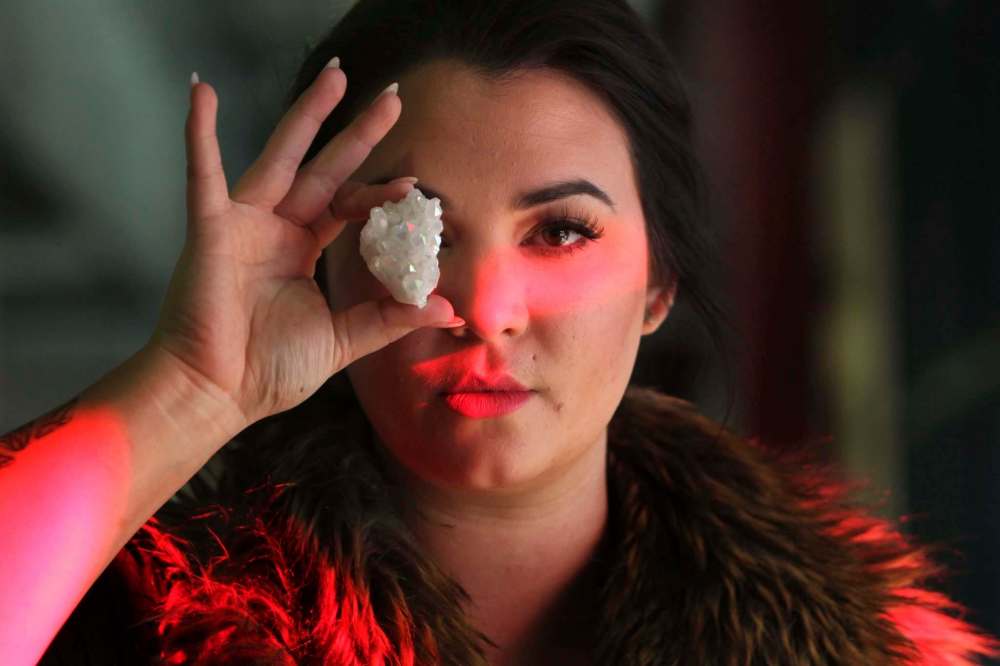
The belief that crystals hold energy and healing properties has been held by many ancient civilizations. It’s also a belief that can be met with skepticism and mockery, dismissed as woo-woo GOOP-y pseudoscience.
“People look at this stuff and go, ‘Oh, you think a rock’s gonna fix you?’” says Vanessa Kunderman, crystal expert and founder of Rogue Wood Supply, a Winnipeg-based online spiritual wellness resource centre and shop.
For the record, no, she doesn’t think a rock’s gonna fix you. But she does believe it can be a tool.
“The crystal isn’t going to cure your mental illness, but the fact that you’re reaching for an anxiety stone and saying, ‘I’m aware that I have anxiety,’ you’ve done the first step in potentially helping yourself by saying, ‘I have an issue, I want to work on it, here’s my little amulet that I’m going to work with every day as a reminder that I’m seeking improvement.’”
Kunderman began Rogue Wood Supply in 2015. Through her shop, she sells crystals, aromatherapy sprays and oils, and birch wands, and she has developed a number of resource materials — including a comprehensive Crystal Directory, so curious crystal neophytes can learn their apatite from their opalite, and the characteristics and attributes of each stone. She also offers crystal readings.
Kunderman has a knack for demystifying the mystic; she’s knowledgeable, but approachable. When we meet, we talk at length about the attraction of crystals, especially among those seeking wellness, healing and balance. They are not a cure-all. Rather, crystals offer a chance to establish a ritual, or a daily practice. They can be used as part of meditation and other mindfulness exercises, and as a form of self-care.
And, as in Kunderman’s case, they are a way to connect with one’s spirituality.
Kunderman got her first crystal while she was undergoing chemotherapy. She lost her father to cancer at 11 and, at 16, was diagnosed with Hodgkins lymphoma. Kunderman’s mother bought her a pendant she’d had her eye on: a black stone with white veining. “I was like, ‘I like that, but I don’t know why.’”
She later learned the veining in her pendant was rutilated quartz.
“The properties of that are when you’re going through spiritual transformations and your energy is depleted — all the properties really made sense for where I was at.”
It was an a-ha moment for Kunderman, one that set her on her current spiritual path.
“I think many people become spiritual after a traumatic event like that,” she says. “I was a hardcore atheist. I think that was a natural reaction to my circumstance. I was angry and I didn’t want to believe in anything.”
People began coming to her for her crystal knowledge, and Rogue Wood Supply was born. But starting a business in the realm of spiritual wellness isn’t without its learning curves, particularly around matters of cultural appropriation. For a while, she was selling smoke-cleansing products at Rogue Wood Supply and calling them “smudge.”
“Which is incredibly incorrect,” she says. “Smudge is something sacred to Indigenous cultures to invite spirit, to use for the ceremonies.” She acknowledged her error fully, apologized and found an alternative. She now makes a point of passing along that knowledge whenever someone asks her, “Is this smudge?”
Kunderman points to the proliferation of palo santo, a sacred wood in South America, that you can now find in stores such as Anthropologie. “It’s everywhere now,” Kunderman says. “It’s the same thing that’s happening with white sage. It’s overharvested, it’s endangered and it’s a sacred thing to this community that we’re now just making popular.”
And when something becomes trendy, it can be hard to separate the authentic from the fake. That’s why, in her business, Kunderman focuses on transparency and education.
“The way to do a spiritual profession, for lack of a better word, well is to be raw, to be vulnerable, to share your mistakes,” she says. “That’s how you know you can trust someone, if you have honest conversations — and invite the uncomfortable conversations.”
For many, crystals act as a talisman or good luck charm — something tangible one can interact with and, as Kiera Fogg puts it, remind them of their highest intentions (kind of like my citrine necklace). Fogg is the founder of the Winnipeg-based company Little Box of Rocks, which allows people to send a gift box of crystals the way they might send a bouquet of flowers. Back in 2015, Cameron Diaz and Gwyneth Paltrow both included Little Box of Rocks on gift guides, and Fogg’s business boomed.
“I stocked up with enough inventory to sell, like, 100 boxes,” she says. “Within a couple months we were doing that every day.”
Fogg was born in Thunder Bay, Ont., land of the amethyst. She collected the purple gems during camping trips, and developed an impressive rock collection. Her reconnection with crystals happened after she became a mom.
“There was a point, as a stay-at-home-mom, where I felt really lost,” she says. “I loved motherhood, but it wasn’t enough for me. I had a real struggle with anxiety, and ended up developing panic attacks.”
So, she turned to crystals — specifically sodalite. “It’s believed that if you tuck it in your pocket, it helps with panic attacks.”
For her, the power of crystals lies in their ability to inspire us and change the way we think. “If a rock can do that,” she says,
“I think that’s pretty magical.”
Some have argued that the appeal of the mystic and cosmic is because it’s so individualistic: one can get a personalized crystal reading, or a tarot reading, or follow their astrological charts and perhaps glean some insight about themselves and why they are they way they are. It’s the same reason personality quizzes are so popular: it’s a human need to feel seen and understood.

But humans also need connection, and things such as crystals and astrology are another way to relate to each other. There’s something fundamentally magical about the idea that we have connections to each other, written in the stars. And crystals — much like any other interest, passion or hobby you can think of — offer ample opportunity for like-minded bonding.
That might explain the craving for covens among today’s young women.
“I just feel like ‘witch’ and ‘women’ are synonyms,” Kunderman says. “Women are so intuitive. We have this strange connection we can’t always explain — and then somewhere along the way, that word was used against us as something bad. In 2018, I feel like there’s going to be this huge push of women reconnecting with each other. Modern spirituality is really modern feminism, I think. It’s about awareness of the self, empowerment of the self and feeling more in control of your voice, really.”
jen.zoratti@freepress.mb.caTwitter: @JenZoratti
Jen Zoratti is a columnist and feature writer working in the Arts & Life department, as well as the author of the weekly newsletter NEXT. A National Newspaper Award finalist for arts and entertainment writing, Jen is a graduate of the Creative Communications program at RRC Polytech and was a music writer before joining the Free Press in 2013. Read more about Jen.
Every piece of reporting Jen produces is reviewed by an editing team before it is posted online or published in print – part of the Free Press‘s tradition, since 1872, of producing reliable independent journalism. Read more about Free Press’s history and mandate, and learn how our newsroom operates.
Our newsroom depends on a growing audience of readers to power our journalism. If you are not a paid reader, please consider becoming a subscriber.
Our newsroom depends on its audience of readers to power our journalism. Thank you for your support.
Jen Zoratti is a columnist and feature writer working in the Arts & Life department, as well as the author of the weekly newsletter NEXT. A National Newspaper Award finalist for arts and entertainment writing, Jen is a graduate of the Creative Communications program at RRC Polytech and was a music writer before joining the Free Press in 2013. Read more about Jen.
Every piece of reporting Jen produces is reviewed by an editing team before it is posted online or published in print – part of the Free Press‘s tradition, since 1872, of producing reliable independent journalism. Read more about Free Press’s history and mandate, and learn how our newsroom operates.
Our newsroom depends on a growing audience of readers to power our journalism. If you are not a paid reader, please consider becoming a subscriber.
Our newsroom depends on its audience of readers to power our journalism. Thank you for your support.
Advertisement Advertise With Us
Advertisement Advertise With Us